Short stays in France
Short stays in France are governed by the rules of the Schengen Area. These rules define the conditions of entry, movement and the maximum stay authorized, including in a professional context.
In a nutshell
- France applies the common rules of the Schengen Area for short stays.
- The maximum duration of the permitted stay is 90 days within any 180-day period, across all Schengen States.
- A Schengen visa enables you to travel within all Member States.
- In the event of a business trip, the nature of the activity exercised must be analyzed distinctly.
- French Overseas Territories are not part of the Schengen Area and are subject to specific entry and stay requirements.
Understanding the Schengen Area
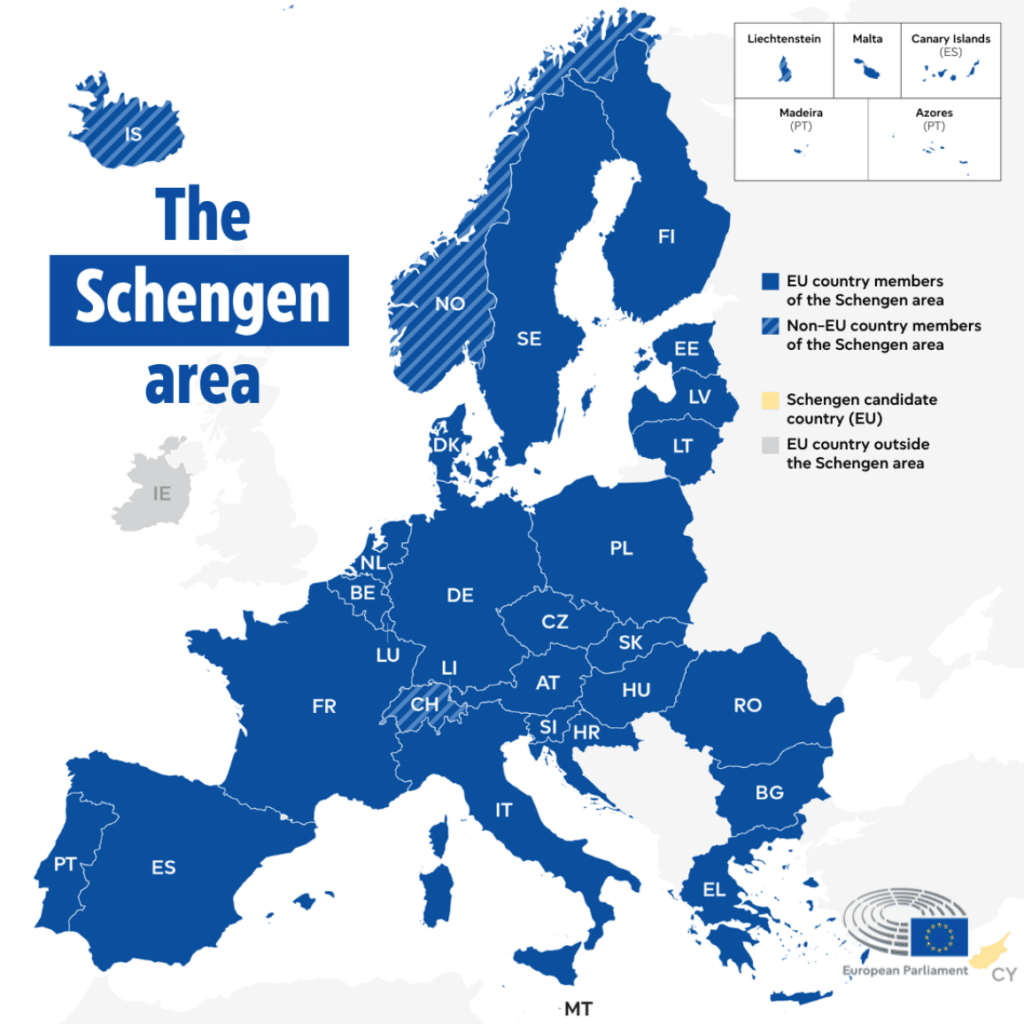
The Schengen Area is an area of free movement of people, grouping together several European Union Member States that have abolished interior border controls.
Once admitted to the territory of one of these Member States, a foreign national may circulate freely throughout the Schengen Area, without internal border controls.
The controls are performed uniquely upon entry into the Schengen area, at the exterior borders.
These rules apply not only to company directors but also employees making occasional trips.
Nationals of the European Union (EU), European Economic Area (EEA) and Swiss citizens enjoy the right to free movement within the Schengen Area.
| Austria | Greece | Poland |
| Belgium | Hungary | Portugal |
| Bulgaria | Iceland* | Portugal |
| Croatia | Ireland | Romania |
| Cyprus | Italy | Slovakia |
| Czech Republic | Liechtenstein* | Slovenia |
| Denmark | Lithuania | Spain |
| Estonia | Luxembourg | Sweden |
| Finland | Malta | Switzerland |
| France | Netherlands | |
| Germany | Norway* |
France’s membership of the Schengen Area allows foreign nationals authorized to enter French territory to travel freely in other Member States.
A Schengen visa issued by the French authorities therefore allows access to all Member States within the Schengen space. The visa sticker specifies the territorial validity of the authorized stay.
Within the Schengen Area, the maximum duration authorized is 90 days out of a rolling period of 180 days.
This rule applies cumulatively to all stays carried out in Member States, and not country by country.
Calculate the maximum duration
An official calculator provided by the European Commission enables you to check that you will respect the maximum length of stay.
Access the calculator
Business trip to France: what are the rules applicable within the Schengen Area?
In a professional context, the Schengen Area constitutes the legal framework applicable to occasional travel to France, particularly for :
- Business meetings or appointments.
- Commercial negotiations.
- Participation in trade fairs or professional events.
- Short-term training courses.
However, the application of the Schengen rules alone is not sufficient to determine whether a professional activity is authorized. The nature of the activity exercised on French territory must be appreciated separately.
Business trip to France
Business travel refers to occasional professional trips, not involving production or direct participation in French economic activity, such as meetings, negotiations, trade shows or internal training.
Temporary salaried assignment
Certain situations constitute an actual professional activity carried out in France, including operational missions, service provision, as well as employee secondment/posting, or other forms of effective work carried out on French territory. These situations fall under a separate legal framework.
Which are the Member States of the Schengen Area?
The Schengen Area includes:
- Participating European Union Member States.
- The Member States of the European Economic Area.
- Switzerland.
Mainland France and Corsica (excluding Overseas départements, territories and collectivities) has been part of the Schengen Area since its creation.
Note
While they are members of the European Union, Cyprus and Ireland are not part of the Schengen Area.
What documents are required to enter the Schengen Area?
- A passport issued less than 10 years ago.
- A passport valid for at least three months after the planned date of departure from French territory.
- A visa depending on the nationality of the applicant.
- Or a visa or a residence permit issued by a Member State of the Schengen Area.
- For a tourist or private stay: Documents specifying the reason, duration and conditions of the stay.
- For a business trip: Documents indicating the visitor’s profession and the establishments or businesses visited.
- Cash, checks, international payment cards or any other means to cover the costs of the stay.
- Travel ticket or proof of return to the country of usual residence.
Required documents
For reference, you can find the list of required documents.
Upon arrival in France
Upon arrival in France from another Schengen State, a non-European foreign national must declare with the competent French authorities, unless they hold a residence permit valid for more than one year issued by another Schengen State.
The French authorities reserve the right to refuse entry to the national territory.
The French overseas départements and regions (French Guiana, Guadeloupe, Martinique, Mayotte, Réunion) are not part of the Schengen Area. Schengen rules do not apply there.
A visa issued for overseas territory does not allow entry into the Schengen Area. A Schengen visa can be applied directly from an overseas territory at the relevant Prefecture.
The French authorities reserve the right to refuse entry to the national territory.
French overseas territories
The French overseas territories are not part of the Schengen Area. To travel to both an overseas territory and the Schengen Area, a separate visa is required for each territory. Before departure, it is recommended to check the territorial validity of the visa and the applicable formalities on France-Visas website.